
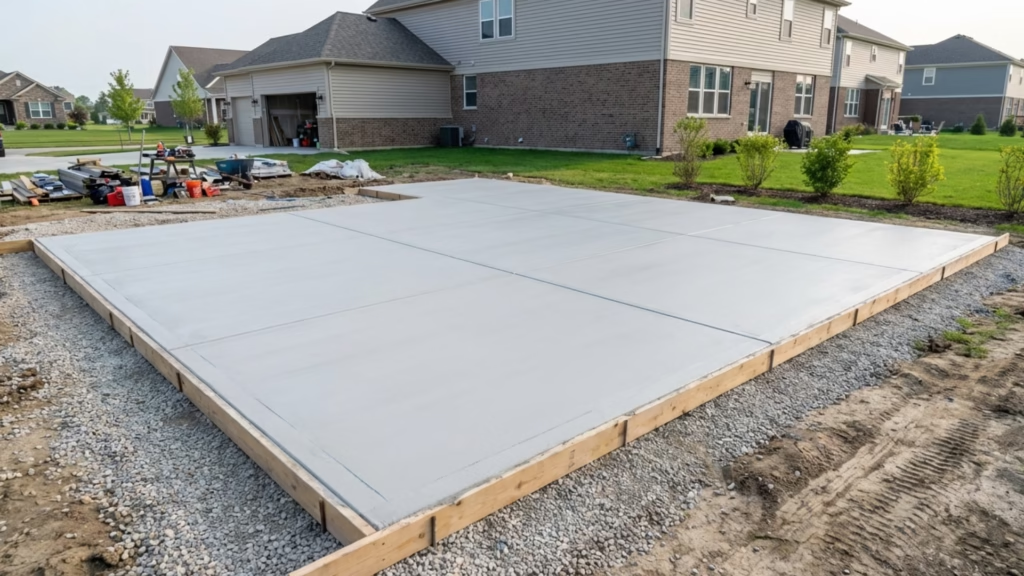
If you are working on a home improvement project in the Queen City, knowing the concrete slab cost upfront is the difference between a smooth project and a budget-breaking surprise.
For example, if you are pouring a base for your new backyard shed in Matthews or a reinforced driveway in Myers Park, this 2026 concrete guide provides you with the most accurate local pricing information and professional advice to effectively plan your project.
According to Angi, the average concrete slab price is between $6.00 and $12.00 per foot for Charlotte, but your final quote will vary significantly based upon the thickness of your pour and the amount of reinforcement needed for North Carolina’s dense red clay soil.
Key factors influencing concrete slab installation cost in 2026
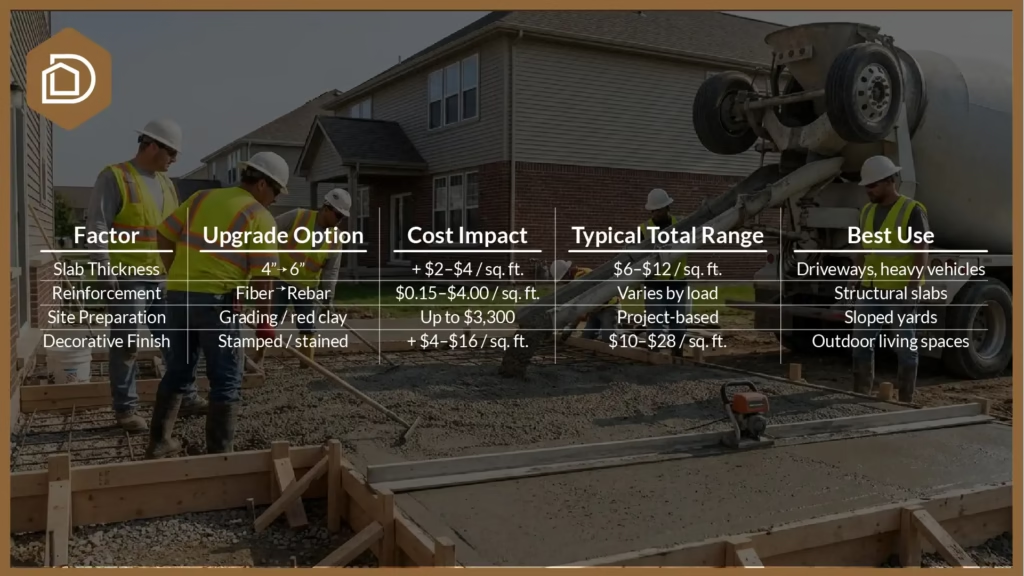
Calculating your concrete slab cost isn’t only based on square footage but rather on the specifications of the project. Material costs will still be consistent in 2026; however, labor and site preparation will be the main cause of price differences in the North Carolina/Charlotte metro area.
- Thickness of slab: If you’re building a patio or walkway, a 4-inch-thick slab could work well; however, if you’re adding a concrete driveway, contractors will typically suggest at least a 6-inch pour to accommodate heavy
With just the 2-inch increase from 4″ to 6″, you can expect your total price to increase by $2.00 to $4.00 per square foot.
- Types of reinforcement: The soil in the 704 area will move very easily, so the use of rebar reinforcement (steel bars) for driveways and foundations is the standard for contractors, which costs approximately $1.40 to $4.00 per square foot Cost-effective options for lighter construction projects, such as shed pads, can include using fibermesh (fibers added into the wet concrete), which costs approximately $0.15 to $0.30 per square foot.
- Site Preparation: Charlotte’s red clay is notorious for being difficult to According to LawnLove (2026), clearing and grading uneven land can add up to $3,300 to your project total depending on the slope of your yard.
How do material types and labor affect Charlotte concrete pricing?
Differences in material cost comparison vs labor rate pricing
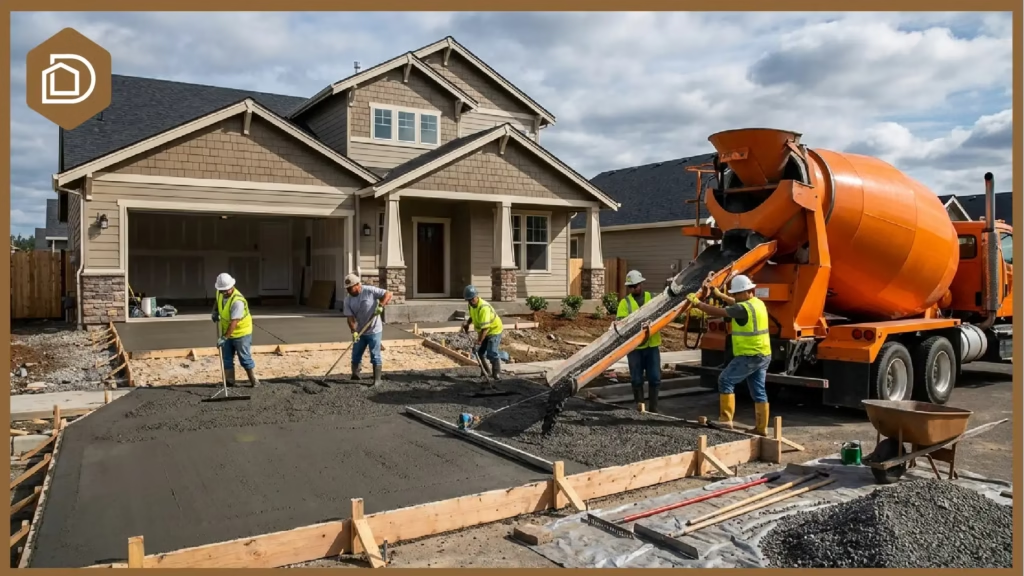
- Materials: On average you can expect to pay between $110 to $165 per cubic yard of ready-mix concrete delivered to your site. If you only order less than a full truck load of ready mix (generally a truck has 10 cubic yards), the short load fee could cost anywhere from $40 to $110 but will be dependent upon where concrete is being delivered to.
- Labor: Typically, professional concrete contractors who install concrete slabs in Charlotte charge between $4.00 and $7.00 per square foot. To actually put the concrete in place, included with those frames (setting forms), pouring the actual concrete, and finishing the surface of the concrete by broom or troweling smoothly.
- Finishing touch: The actual texture of your finish will greatly change the overall cost of your slab. Many times, if you select a basic broom finish, it will be included as a labor part of your estimate, and the prices will generally be the same regardless of who installed it.
But the cost of stamping “like stone or wood look” is generally between $10 and $18 per square foot because it requires special tools and more than 1 day’s labor for both the staining and sealing by a professional concrete contractor such as Durafy.
Residential vs. Commercial Concrete Slab Cost
Residential concrete standards (The "704 Home" Baseline)
For projects in neighborhoods like South End or University City, residential slabs focus on aesthetics and light load-bearing.
- Spec: Typically 3,000–3,500 PSI.
- Reinforcement: Often uses fiber mesh or lighter #3 rebar.
- Cost Focus: You pay for accessibility. If a contractor has to wheelbarrow concrete to a sloped backyard in Plaza Midwood, labor costs spike by $2.00–$4.00 per sq. ft.
Commercial concrete standards (High-Traffic Foundations)
If you’re building a commercial workshop or a retail pad in Pineville, the requirements are much stricter.
- Spec: 4,000+ PSI is the standard to handle heavy machinery and constant forklift traffic.
- Thickness: Rarely less than 6 inches, often 8–10 inches.
- Cost Focus: You pay for testing and compliance. Commercial jobs require soil compaction testing and concrete “slump” tests to meet building codes, adding roughly $1,500–$3,000 in fixed fees to the project.
Pro Tip: Scaling your project for better ROI
If you are planning a 100-sq.-ft. shed pad, ask your concrete contractor what it would cost to add a small walkway or a trash pad at the same time.
As HomeAdvisor notes, adding a secondary small pour to a larger job can lower your overall price per square foot because the truck and crew are already on-site. In Charlotte, “bundling” your concrete work is the smartest way to bypass those pesky short-load fees and get a high-end look for less.
The Durafy difference: A step-by-step guide to a perfect concrete slab
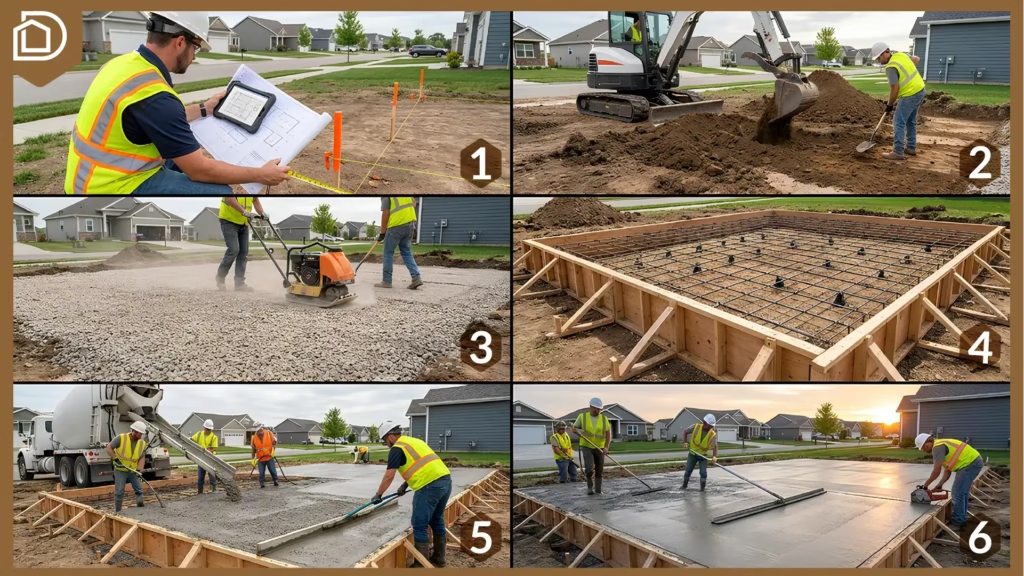
You are not just paying for wet cement when considering the cost of a concrete slab; you are paying for a level foundation that can be maintained for many years to come. Here is how we approach your installation:
- 2D Site Assessment
At Durafy, all of our projects begin with a 2D site visit to capture the size and layout of your property, as well as assess the area for the slope and drainage patterns. This gives us an accurate estimate and makes sure that the water will be flowing away from your home, rather than towards it. - Digging and Stabilizing the Subgrade
We dig down deep. This includes excavating to the point where there is enough concrete and structural base material to provide a long-lasting concrete surfacing that will perform well for years to come. We identify and stabilize soft spots found in the subgrade (the natural soil below the concrete) in order to have a solid and firm base upon which to install your concrete slab. - Capillary Break (Subbase Compaction)
We never pour concrete directly on bare dirt; instead, we install a layer of compacted rock (typically, #57 or ABC stone) at least 4 inches thick, to create a barrier to moisture migrating upward into the concrete slab and to provide a smooth and level surface for placing the concrete on. This also provides the single best way to prevent spiderweb type cracks. - Heavy-Duty Formwork & Reinforcements
We build high-tolerance formwork braced to handle the pressure of the pour. For reinforcement, we use rebar reinforcement (typically #3 or #4 bars). - During the Pouring Process and Consolidation Mechanically
To ensure the best freeze-thaw cycle in North Carolina, we use high quality concrete with compressive strengths between 3,500 PSI and 5,000 PSI. After the concrete has been poured, we mechanically vibrate the concrete to consolidate it properly so there are no voids left behind, which could cause the concrete to fail structurally over time. - Specialty Finishing and Control Joints
Depending on how you want your slab finished (i.e., broom finish, trowel finished, or stamped), we will perform your finish while the concrete is still in its “plastic,” or unfinished state. In addition, control joints will be placed at calculated intervals to allow for natural shrinkage and when the concrete does crack, it will crack inside the control joint.